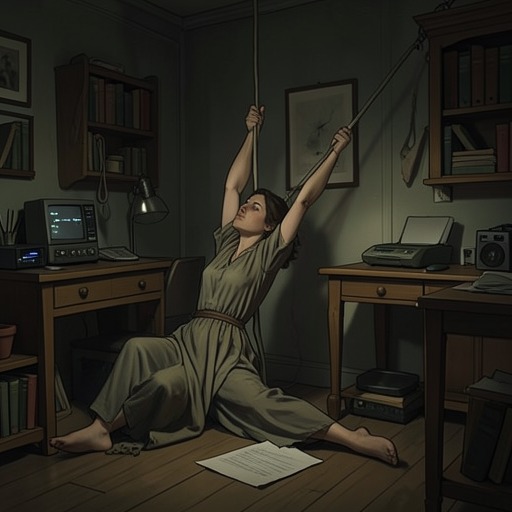
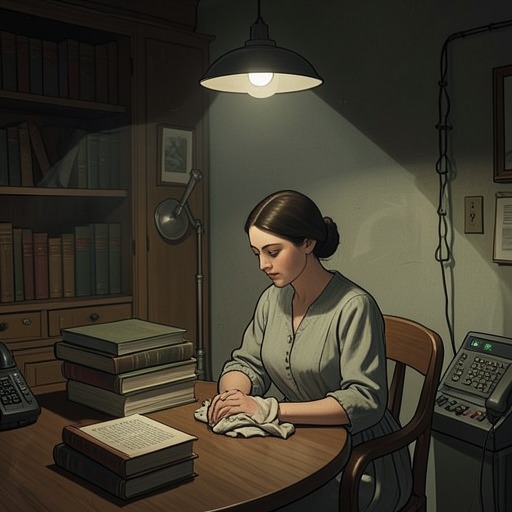
Cassette tapes recorded by Michael
The ReaderMichael’s recorded readings are the central medium of his long, carefully bounded contact with Hanna during her imprisonment. What begins as a way to read through sleepless nights becomes a sustained exchange without direct conversation: Michael sends books in his voice, Hanna learns to read by following them, and her short written notes return across the silence. The tapes help Hanna move from dependence toward literacy, but they also preserve the distance Michael chooses between them.
Origin and First Package
After separating from Gertrud, Michael lies awake for much of the night. Reading silently makes his eyes close; putting the book down leaves him wide awake. Reading aloud keeps him alert, and, amid memories and dreams in which Hanna repeatedly predominates, he begins to read for her. He records the Odyssey, turning an intimate act of reading into a message that can travel to the prison where she is serving her sentence.
The first package is delayed by Michael’s hesitation and by the scale of what he wants to send. He waits until he has recorded the entire Odyssey rather than sending fragments, then doubts whether Hanna will find it interesting enough. He adds stories by Schnitzler and Chekhov, postpones contacting the court that convicted her to learn where she is imprisoned, and finally assembles the recordings, a cassette player, and Hanna’s address at a prison near the city of her trial. The tapes are numbered in reverse order of the reading sequence, from Chekhov to Schnitzler to Homer. The package is therefore not an impulsive gesture but a delivery Michael has prepared and delayed until he can send a substantial beginning.
A Long-Running Reading Practice
Michael later finds a notebook listing what he recorded. The first twelve titles appear to have been entered together; he seems at first to have read without keeping a record, then realized that he might forget what he had already sent. He dates some later entries but not others. Even without a complete chronology, he remembers that the first package went out in the eighth year of Hanna’s imprisonment and the last in the eighteenth, the year her plea for clemency was granted.
The selection follows Michael’s own reading life. He generally records what he wants to read at the time, including books he already knows and loves. Hanna hears works by Keller and Fontane, Heine and Mörike, as well as the Odyssey and the stories of Schnitzler and Chekhov. Michael is initially reluctant to record poetry, but comes to enjoy reading it and learns many poems by heart. He also observes that reading aloud takes longer than silent reading, yet leaves books unusually vivid in his memory: the extra duration is a cost, while the act of voicing and recording becomes a form of lasting recollection.
The notebook’s range also reflects Michael’s confidence in established bourgeois literature. He does not recall asking whether he should move beyond writers such as Kafka, Frisch, Johnson, Bachmann, and Lenz to experimental works whose stories or characters he might not recognize or like. He assumes experimental literature would be experimentation with the reader, something neither Hanna nor he needed. The recordings therefore transmit not only individual books but Michael’s own limits of taste and judgment.
Production, Silence, and Control
As Michael begins writing, he adds his own work to the tapes. He first dictates a handwritten text, revises the typewritten version, and waits until it feels finished. Reading it aloud provides a further test: if the reading does not feel right, he can revise and record over the earlier version. He dislikes overwriting a recording, however, because he wants the spoken reading to serve as a culmination. Hanna becomes the court before which he gathers his creative and critical energies; only after reading to her does he send the manuscript to a publisher. The tape gives his private work an imagined listener and judge before it enters public circulation.
That listener is kept at a deliberate remove. Michael makes no personal remarks, asks no questions about Hanna, and tells her nothing about himself. He announces the title and author, reads the text, waits briefly when it ends, closes the book, and presses Stop. The recordings carry his voice and chosen reading matter, but not an ordinary conversation. A fixed sequence of literary text, pause, and cutoff makes the boundary audible: communication continues, while personal disclosure is withheld.
Michael never establishes a regular schedule. Sometimes a new cassette follows after a week or two; at other times, vacation or busyness leaves three or four weeks between recordings. He continues sending them even after Hanna can read on her own. When he spends a year in America, he sends tapes from there as well. Distance and irregular intervals do not end the practice, because he understands reading aloud as his way of speaking to Hanna and being with her—not as a remedial service that becomes unnecessary once she can read independently.
Hanna’s Response and Literacy
In the fourth year of their word-driven, wordless contact, Hanna sends a note thanking Michael for the last story. Its physical form makes the difficulty of this new reply unmistakable: notebook paper has been torn out and cut smooth, and the short message sits near the top. The blue ballpoint writing is heavily pressed; the letters have gone through to the other side, as has the address, whose imprint remains legible across the folded paper. Her writing can look at first like a child’s, but the narrator distinguishes its force from a child’s wandering hand. Hanna has to make each line and letter happen through effort, starting strokes again and forcing them into words.
The note brings Michael joy because it demonstrates that Hanna can write. He has spent these years reading about the dependence illiteracy imposes in ordinary life: finding a way or an address, choosing a meal, relying anxiously on familiar routines, and using energy to conceal the inability to read and write. In his understanding, the effort Hanna has made to learn represents a step away from dependence and toward independence and liberation. The recordings have not, by themselves, taught her literacy, but they become the material she works through in order to acquire it.
Hanna’s notes continue after the first one. They remain brief, offering thanks, requesting more or less of a particular author, or commenting on a poem, story, character, or prison life. Their observations are often sharp. She compares Schnitzler and Stefan Zweig, says Keller needs a woman, describes Goethe’s poems as tiny pictures in beautiful frames, and judges that Lenz must write on a typewriter. Because she initially knows so little about the authors, she tends to imagine them as contemporaries unless the text makes that impossible. Her reading through the tapes thus produces an unexpected encounter with literary history: older works can appear to her as descriptions of life in foreign countries rather than as relics from a remote past.
The correspondence also draws attention to things Michael might otherwise overlook. Hanna writes that the forsythia is flowering in the yard, that she likes the summer storms, or that birds are gathering to fly south. Her remarks are often what first make Michael notice those details. The tapes carry books into the prison, while Hanna’s replies send back a sharpened attention to the natural world beyond the recordings’ literary program.
Material Traces and the Limits of Contact
Michael keeps Hanna’s notes and later notices the change in her handwriting. At first she forces the letters into a consistent slant and into the right height and width. Once she has managed this, her hand grows lighter and more confident. It never becomes fluid, but acquires a severe beauty associated with the writing of people who have written little in their lives. The change offers a visible record of practice: the labor initially impressed through the page gradually becomes more controlled, without disappearing altogether.
Years later, Michael sees the cassette machine and the tapes in Hanna’s cell. The machine sits among books and ordinary belongings, and the recordings he made are stored on the lower shelves. Not all are there: Hanna has lent some to the aid society for blind prisoners. This later use extends the tapes beyond the private connection for which Michael made them, allowing the recordings to serve other listeners as well.
The machine has also been part of Hanna’s struggle to learn. She borrows from the library the books Michael reads and follows the tapes word by word and sentence by sentence. The repeated switching on and off, rewinding, and fast-forwarding strains the cassette player until it repeatedly breaks down and must be repaired. The warden discovers what Hanna is doing because repairs require permission. Hanna initially does not want to explain herself, but when she begins writing too and asks for a writing manual, she no longer hides the effort; she is proud of succeeding and wants to share that happiness.
The tapes’ importance is inseparable from what they cannot do. They allow Hanna to hear Michael regularly, and their repeatability lets her match spoken words to printed ones at her own pace. Yet Michael never writes to her, and the recordings contain no personal remarks or questions. Hanna hopes he will write; when mail is distributed, her question about whether there is a letter for her is not a request for another tape package. His voice has reached her for years, but the silence around that voice remains consequential. The tapes sustain contact, enable learning, and preserve a distance that Hanna’s notes cannot fully close.